
Choosing the right software development methodology is one of the most important decisions you’ll make before a project begins. The development approach influences everything, from how the team collaborates and communicates with stakeholders to how changing requirements are managed throughout the project.
Among the many software development methodologies available today, Agile and Waterfall remain the two most widely recognized. While both aim to deliver successful software, they follow fundamentally different approaches, making each better suited to certain types of projects.
Because Agile emphasizes flexibility and continuous improvement, it’s often viewed as the default choice for modern software development. Meanwhile, Waterfall is sometimes dismissed as an outdated methodology. In reality, projects with clearly defined requirements and stable scopes often benefit from Waterfall’s structured and predictable process.
Ultimately, choosing between Agile and Waterfall isn’t about selecting the more modern methodology, it’s about identifying the approach that best aligns with your business objectives, project complexity, and team collaboration style.
In this article, we’ll explore how Agile and Waterfall differ, how each methodology works, and when each is the most appropriate choice for software development.
Why Choosing the Right Development Method Matters
No two software projects are exactly alike.
Some projects begin with detailed requirements that are unlikely to change, while others evolve continuously as user feedback is collected or business priorities shift. Because every project has unique characteristics, a single development methodology cannot effectively fit every situation.
A development methodology serves as the framework that guides planning, execution, monitoring, and project delivery. It establishes a consistent workflow so that everyone involved understands project milestones, responsibilities, review processes, and how changes should be handled.
Since the chosen methodology affects nearly every stage of software development, from initial planning to deployment, it plays a significant role in determining the project’s overall success.
What Is the Waterfall Model?
Waterfall is a traditional software development methodology that follows a sequential, step-by-step process. Each phase must be completed before moving on to the next, creating a structured and predictable workflow.
This methodology places significant emphasis on planning. Before development begins, project requirements are typically analyzed, documented, and approved to establish a clear project scope.
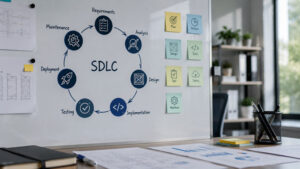
A typical Waterfall project follows these stages:
- Requirements analysis
- System design
- Software development
- Testing
- Deployment
- Maintenance
Because every phase builds upon the previous one, making substantial changes after development has started can be difficult and expensive. For that reason, Waterfall is best suited for projects with well-defined requirements that are unlikely to change throughout development.
What Is Agile?
Agile is an iterative software development methodology that divides projects into short development cycles known as sprints.
Instead of waiting until the entire application is complete, each sprint delivers a working portion of the software that can be tested, reviewed, and improved based on stakeholder feedback.
This incremental approach enables businesses to see progress earlier and make adjustments throughout the project rather than after development has finished.
Agile also encourages close collaboration between developers and clients. Frequent communication ensures the software continues to align with changing business priorities, making it particularly effective for projects where requirements are expected to evolve.
Because of its adaptability, Agile has become one of the most widely adopted methodologies for modern software development.
Key Differences Between Agile and Waterfall
Although both methodologies aim to produce high-quality software, they differ significantly in how projects are managed.
Development Workflow
Waterfall follows a linear process in which each phase is completed only once before moving to the next stage.
Agile, on the other hand, follows an iterative cycle. Development occurs through multiple sprints, allowing the product to be continuously refined based on testing and user feedback.
Managing Changes
With Waterfall, changes introduced after development has begun often require revisions to documentation, timelines, and project scope. As a result, the methodology works best when requirements are finalized early.
Agile is designed to accommodate change. New ideas, feature requests, and user feedback can be incorporated into future sprints without disrupting the entire project.
Client Involvement
Waterfall typically involves clients heavily during the planning phase and again near project completion when the software is ready for delivery.
Agile encourages ongoing collaboration throughout the project. Clients regularly review progress, provide feedback, and help prioritize upcoming work, ensuring the final product continues to meet business needs.
When Is Waterfall the Better Choice?
Although Agile receives much of the attention today, Waterfall remains an excellent choice for many projects.
It performs particularly well when project requirements are stable, thoroughly documented, and unlikely to change.
Waterfall is often the preferred approach when:
- Project requirements are clearly defined from the beginning.
- Changes are expected to be minimal.
- Extensive documentation is required.
- Budgets and timelines must be established upfront.
- The project must comply with strict standards or regulatory requirements.
Its structured workflow makes project planning, tracking, and quality control easier by ensuring each phase is completed before the next begins.
When Should You Choose Agile?
Agile is generally a better fit for projects where requirements are expected to evolve over time.
Businesses frequently discover new ideas once users begin interacting with early versions of the product. Agile allows these insights to be incorporated into future iterations without restarting the project.
Agile is particularly suitable when:
- Business requirements are still evolving.
- Stakeholders want to provide ongoing feedback.
- Feature priorities may change over time.
- The software will continue to evolve after its initial release.
- Collaboration between clients and developers is frequent and ongoing.
This flexibility enables organizations to deliver software that remains closely aligned with real-world business needs as they change.
Is Agile Always Better Than Waterfall?
Not necessarily.
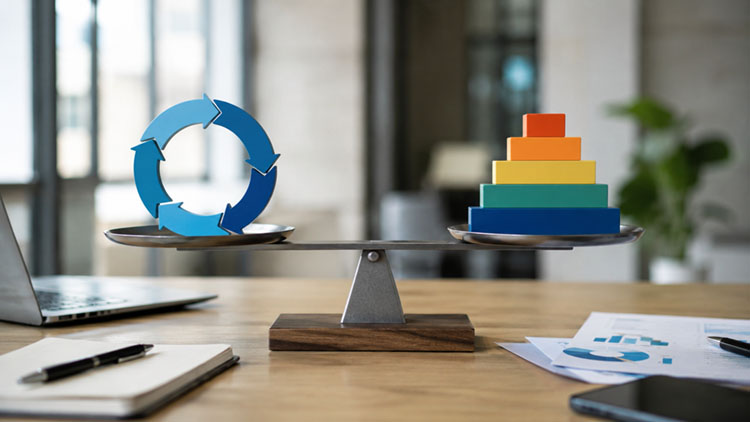
Neither methodology is universally better than the other. Each has strengths and trade-offs, and the right choice depends entirely on the nature of the project.
Agile offers greater flexibility but requires active stakeholder participation, frequent communication, and continuous collaboration throughout development.
Waterfall, meanwhile, provides a more structured process with comprehensive documentation and predictable planning. However, it becomes less efficient when project requirements change significantly after development begins.
Instead of choosing a methodology based on popularity, consider factors such as:
- How well-defined your requirements are.
- The likelihood of changes during development.
- The complexity of the software.
- Available budget and timeline.
- The level of stakeholder involvement throughout the project.
Evaluating these factors will help you select a methodology that supports long-term project success rather than simply following industry trends.
How Software Development Companies Choose the Right Methodology
In practice, experienced software development companies rarely rely on a single methodology for every project.
Before development begins, they evaluate several factors, including business objectives, project scope, technical complexity, expected timelines, and long-term goals.
Based on this assessment, they recommend the development approach that best fits the project’s unique requirements. In many cases, teams even combine elements of Agile and Waterfall, creating a hybrid workflow that balances flexibility with structured planning.
This is one reason why choosing an experienced software development company is so important. Rather than applying a one-size-fits-all process, a skilled partner will tailor the methodology to maximize the project’s chances of success.
Selecting the Best Approach Starts with Understanding Your Business
Agile and Waterfall are not competing methodologies where one consistently outperforms the other. Instead, each was designed to solve different types of project challenges.
Waterfall excels when project requirements are clearly defined and unlikely to change, providing a structured and predictable development process. Agile, by contrast, is ideal for projects that require continuous refinement, rapid feedback, and the flexibility to adapt as business needs evolve.
Before choosing a development methodology, focus first on understanding your business goals, project requirements, and the level of change you anticipate throughout development.
If you’re planning a software project and need guidance on selecting the most suitable development approach, the Bali Gatra team is ready to help. Through our software development services, we work closely with businesses to identify the right strategy, build scalable digital solutions, and support projects from initial planning through successful deployment. Feel free to contact Bali Gatra to discuss your project and explore the best path forward.