


Building high-quality software requires far more than writing clean code. Reliable applications and business systems are created through a structured process that begins with understanding business needs, continues through planning and development, and extends well beyond deployment with ongoing maintenance and improvements.
Without a clearly defined development process, software projects become significantly more vulnerable to delays, budget overruns, changing requirements, and products that ultimately fail to meet user expectations. These challenges often arise not because of technical limitations, but because the project lacks a consistent methodology to guide decision-making throughout development.
To minimize these risks, professional software development companies rely on the Software Development Lifecycle (SDLC) as a framework for managing every phase of a project. SDLC provides a structured workflow that helps teams make informed decisions based on planning and analysis rather than reacting to problems as they arise.
In previous articles, we explored software development as the process of creating digital solutions that solve business challenges. The Software Development Lifecycle serves as the roadmap that organizes this process—from the earliest planning stages through deployment and long-term system maintenance.
What Is the Software Development Lifecycle (SDLC)?
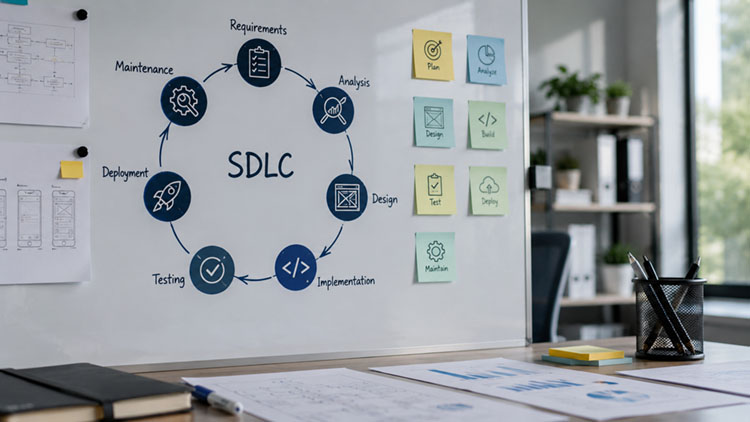
The Software Development Lifecycle (SDLC) is a structured framework that defines the major phases involved in building software. These stages typically include requirements analysis, system design, development, testing, deployment, and ongoing maintenance.
The primary objective of SDLC isn’t simply to produce software that functions correctly. Instead, it provides a systematic process for ensuring quality, improving development efficiency, controlling project costs, and reducing potential risks throughout the project lifecycle.
For smaller projects, SDLC helps teams stay organized and avoid mistakes caused by insufficient planning.
For larger initiatives involving multiple stakeholders, the framework establishes a shared understanding of project goals, responsibilities, timelines, and deliverables, making collaboration significantly more effective.
Although individual companies may implement different workflows or methodologies, the core principle of SDLC remains the same: dividing software development into clearly defined stages that build upon one another.
This structured progression allows teams to review decisions at every phase, identify issues early, and resolve problems before they become costly.
For this reason, SDLC serves as the foundation of professional software development services. Rather than developing software through trial and error, experienced teams follow a proven process designed to produce scalable, reliable solutions that support long-term business objectives.
Why Is SDLC Important?
A typical software project involves many different roles working together, including business analysts, project managers, UI/UX designers, software engineers, quality assurance specialists, and the end users who will ultimately rely on the system.
Without a structured process, coordinating these teams becomes increasingly difficult, leading to communication gaps, inconsistent expectations, and unnecessary delays.
SDLC addresses this challenge by providing a shared framework that guides every phase of development.
The process generally begins with understanding business requirements, followed by system design, software development, testing, deployment, and ongoing maintenance. Because each phase has clearly defined objectives, teams can focus on completing one stage successfully before moving to the next.
Beyond improving software quality, SDLC also delivers significant business benefits.
Organizations can:
- Plan resources more effectively
- Improve budget management
- Reduce project risks
- Control unexpected changes
- Build software that supports long-term business growth
It’s important to note that SDLC is not a development methodology like Agile or Waterfall.
Instead, SDLC defines what stages exist in the software development process, while methodologies such as Agile and Waterfall determine how those stages are executed.
The Main Stages of the Software Development Lifecycle
Although every software project differs in size and complexity, most follow the same fundamental SDLC phases. Each stage builds upon the previous one, creating a structured process that helps teams deliver software aligned with business goals.
Requirements Analysis
Every project begins by identifying the business problem that needs to be solved.
During this phase, the development team works closely with stakeholders to understand:
- Business objectives
- Existing workflows
- User requirements
- Required features
- Technical constraints
- System integrations
The more comprehensive this analysis is, the less likely the project will require major changes once development is underway.
For many projects, thorough requirements gathering becomes one of the most important factors in achieving a successful outcome.
System Design
Once requirements have been documented, the team designs the technical solution.
This stage typically includes:
- Software architecture
- Database design
- User interface (UI)
- User experience (UX)
- Application workflows
- Communication between system components
The resulting design documentation serves as the blueprint for developers throughout the project.
For larger software systems, detailed design documentation also improves collaboration among team members while reducing the likelihood of misunderstandings during implementation.
Software Development
After the design is approved, developers begin building the application according to the agreed specifications.
This phase includes creating:
- Business logic
- Application features
- Database integration
- APIs and third-party integrations
- User interfaces
Rather than developing every feature at once, modern software projects often build functionality incrementally.
This allows individual modules to be reviewed, tested, and refined before development continues, helping maintain quality while simplifying future improvements.
Testing
Before software is released, it undergoes comprehensive testing to verify that it performs as expected.
Testing helps ensure:
- Features work correctly
- Business requirements are met
- Performance is acceptable
- Security vulnerabilities are minimized
- Compatibility across devices and browsers
- Overall system stability
By identifying issues before deployment, testing significantly reduces the likelihood of operational problems once users begin relying on the software.
Deployment
After testing has been successfully completed, the software is released into the production environment.
Deployment often involves more than simply making the application available.
Additional tasks may include:
- Server configuration
- Cloud deployment
- Data migration
- Final system verification
- User onboarding
Many organizations choose a phased rollout strategy, gradually introducing the software to minimize operational risks and ensure a smooth transition.
Maintenance
Launching software is not the end of the development lifecycle.
As businesses evolve, their software must evolve alongside them.
Maintenance typically includes:
- Bug fixes
- Performance optimization
- Security updates
- Feature enhancements
- Technology upgrades
- Support for changing business requirements
Regular maintenance keeps software secure, reliable, and capable of supporting the organization’s growth for years to come.
SDLC Doesn’t Mean Every Project Follows the Same Approach
One common misconception is that SDLC itself is a software development methodology.
In reality, SDLC defines the stages of software development, while different methodologies determine how those stages are executed.
For example, one team may complete each phase sequentially from beginning to end, following a traditional Waterfall approach.
Another team may work iteratively, releasing software in smaller increments to gather early feedback and continuously improve the product—a workflow commonly associated with Agile.
Both approaches still follow the Software Development Lifecycle; they simply organize and execute the stages differently based on the project’s requirements.
This flexibility is one reason experienced software development companies evaluate each project individually before recommending the most appropriate methodology.
Why Understanding SDLC Leads to Better Software Projects
The Software Development Lifecycle provides a proven framework that guides software projects from the initial business discussion through long-term maintenance after deployment.
By following clearly defined stages, organizations can better manage timelines, budgets, software quality, and project risks while maintaining greater transparency throughout development.
Understanding SDLC also improves communication between businesses and development teams. Each phase has clear objectives, deliverables, and review points, making it easier to monitor progress, make informed decisions, and adapt when business requirements change.
If you’re planning a software project, Bali Gatra provides structured software development services backed by transparent communication and decades of industry experience. By establishing the right development process from the very beginning, we help businesses build scalable, reliable software solutions that continue delivering value as their organizations grow.